Retro
Revives classic web aesthetics with pixel details and vintage palettes.
- Version
- v1.0.0 · Updated Jul 18, 2026
- Context
- ≈1,858 tokens
- Security
- ✓ scanned
- License
- Single seat
- Works with
- Claude Code, Cursor, Codex
Checkout opens soon · launches at $9
≈1,858 tokens · v1.0.0
Live demo — an original page built in the Retro style. Open in new tab
About this skill
A nostalgic design system that brings back classic web aesthetics, pixelated details, and vintage color palettes. Its live demo renders a developer docs page — code blocks, parameters table, API reference, and changelog.
The skill file
Retro brings back the warm, tactile charm of the early personal-computing web: square corners, chunky outlined frames, hard offset shadows, pixel-display type, and a sun-faded vintage palette. It feels playful, handmade, and full of personality — a deliberate rebellion against the smooth, shadowless minimalism everywhere else. Reach for it when you want an interface that grins back at the user: indie games, hobby projects, developer tools with attitude, and playful product pages.
Design principles
- Square everything. Zero border radius is non-negotiable — pixels don't have rounded corners.
- Hard shadows, no blur. Elevation comes from solid offset blocks that look stacked like stickers.
- Chunky, visible structure. Thick borders and framed "windows" make the interface feel physical.
- Warm, faded palette. Colors look slightly aged — like a well-loved cartridge or a sun-bleached poster.
- Pixel and mono type. Display type is blocky and proud; body type is tall monospace.
- Tactile feedback. Buttons physically depress; cursors blink; focus inverts colors.
Color
The world is warm and paper-like: a faded cream background #F4E9D8 with a lighter #FBF3E2 surface for framed panels. The primary accent is a burnt orange #E8552D, supported by a deep navy #2B4C7E, with mustard #F2B233 and forest green #2E7D5B filling out the vintage swatch set. Everything is outlined and grounded by a dark espresso #3A2E2A used for borders and block shadows. Foreground text is #2A211C and muted text #7A6A5A.
Light (day) token reference:
- Background
#F4E9D8, Surface#FBF3E2, raised panel#FBF3E2with a hard block shadow. - Primary
#E8552D, Primary hover#D14524, Primary pressed#B83A1D. - Secondary navy
#2B4C7E, Accent mustard#F2B233, Accent green#2E7D5B. - Foreground
#2A211C, Muted#7A6A5A, Border and shadow#3A2E2A, Focus inversion uses#3A2E2Aand#F4E9D8.
For a "night mode" variant, switch to a dim CRT feel: background #1B1714, surface #241E1A, foreground #EDE0CC, borders and shadows in #0F0C0A, with the same warm accents glowing slightly brighter. An optional faint scanline overlay sells the vintage monitor effect.
Night (CRT) token reference:
- Background
#1B1714, Surface#241E1A, Border and shadow#0F0C0A. - Primary
#FF6A3D, Secondary#5C82C4, Mustard#FFC857, Green#4CAF82. - Foreground
#EDE0CC, Muted#A8957E.
Fill recipes: dithered accent panels use a 2px checkerboard of the swatch color over #FBF3E2; title bars fill solid with a swatch color and use cream #F4E9D8 text. Keep no more than two saturated accents competing in a single framed window.
- Typography
- Layout & spacing
- Components
- Motion
- Accessibility
- Use it with your AI tool
Preview ends here
Typography, Layout & spacing, Components, Motion, Accessibility & Use it with your AI tool unlock when checkout opens. Get notified
What's inside
- SKILL.md7.4 KB
More in Design
View allEditorial Pack
Collects the editorial cluster — typography-led, content-first pages in one install.
Design Systems Pack
Bundles every aesthetic design system in one install — switch styles per project.
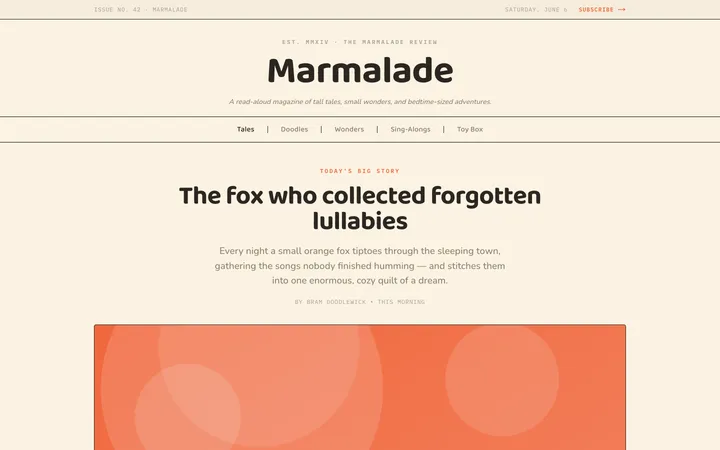
Fiction
Illustrates children's-book warmth with bold outlines and saturated color.

Arcade
Presses chunky pixel buttons and rainbow shadows into arcade-cabinet fun.
More from @staqd
View profileEditorial Pack
Collects the editorial cluster — typography-led, content-first pages in one install.
Design Systems Pack
Bundles every aesthetic design system in one install — switch styles per project.
Fiction
Illustrates children's-book warmth with bold outlines and saturated color.
Arcade
Presses chunky pixel buttons and rainbow shadows into arcade-cabinet fun.